How 3D Cutaway Visualization Could Help Homeowners Understand Insulation Performance
Ask any spray foam salesperson what the hardest part of the pitch is, and it's rarely the price. It's explaining, convincingly, why a material the homeowner will never actually see is worth paying more for than fiberglass batts they can picture perfectly well.
The Communication Gap, Specifically
Once spray foam is applied to a wall cavity, attic, or roof deck and covered by drywall or decking, it's gone from view permanently. A salesperson is left describing R-value numbers, air-sealing benefits, and moisture performance in the abstract — concepts that are real and well-documented (see this site's sister resource, Spray Foam Science, for the underlying building-science detail) but genuinely hard to make vivid to someone who has never seen the material installed and never will.
A cutaway diagram in a brochure helps some. A verbal explanation of "air changes per hour" helps less. Neither lets a homeowner directly compare what's actually happening inside a foam-insulated wall versus a fiberglass-insulated wall side by side, in a way that feels concrete rather than abstract.
What a VR Walkthrough Would Actually Add
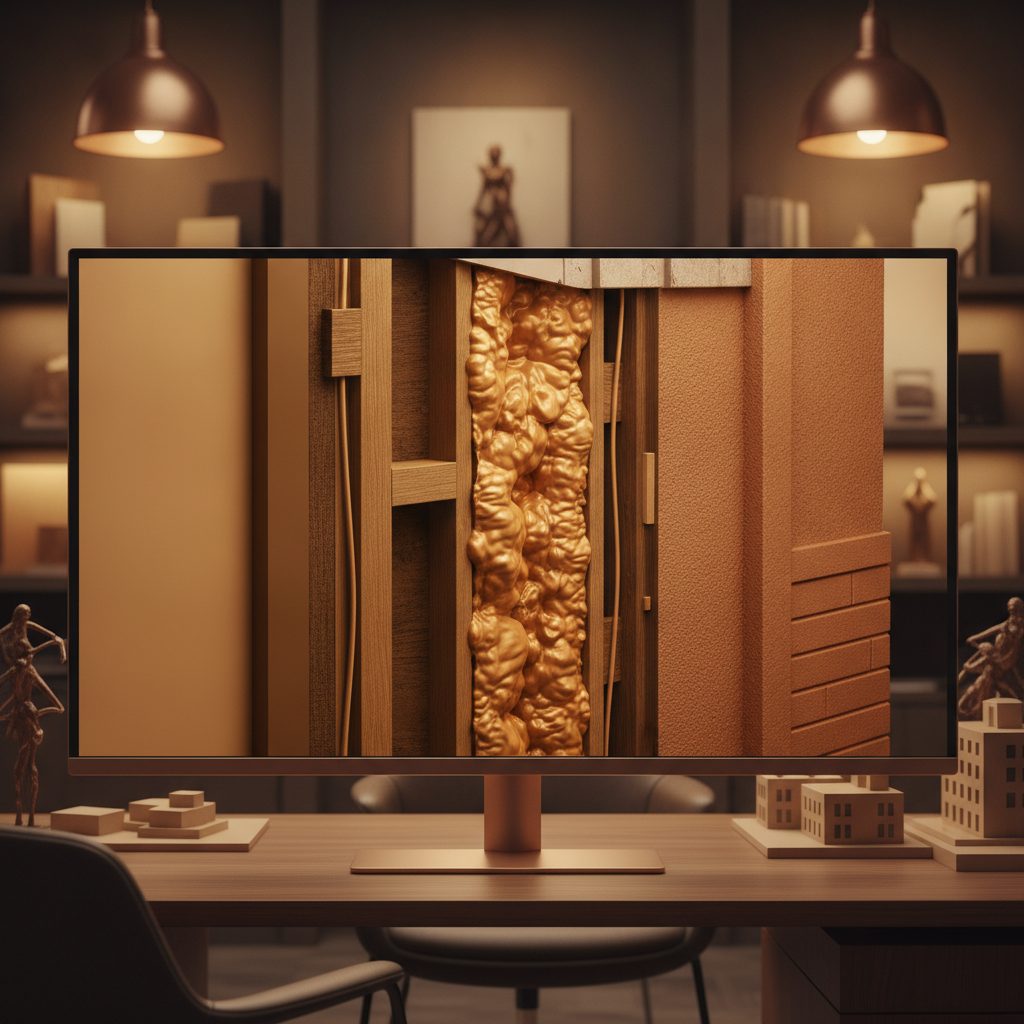
The core idea is straightforward: let a homeowner put on a headset and stand inside a simplified 3D model of their own home's wall or attic assembly, then toggle between an uninsulated or poorly insulated version and a properly sealed spray foam version. Pair that with a visual representation of heat loss — something like a simplified thermal-imaging overlay — during a simulated cold night, and the abstract R-value comparison becomes something the homeowner directly perceives rather than has to take on faith.
This isn't a new category of VR application in general — architectural and real estate VR walkthroughs already let homebuyers experience a floor plan before it's built, and that category is mature and well-proven. What would be new is applying that same walkthrough approach specifically to insulation performance comparison, which nobody has built as a dedicated product yet.
The Part That's Easy to Get Wrong
The single biggest risk with a tool like this is visual exaggeration. It would be easy to build a version where spray foam "glows warm and cozy" and fiberglass "glows cold and drafty" as a pure marketing effect with no real physics underneath it — and that would be a liability, not an asset. A trustworthy version needs its thermal behavior actually grounded in real R-value ranges, vapor-permeance classes, and assembly-specific physics, or it's just a more expensive, more convincing way to oversell.
Where This Actually Sits Today
No dedicated spray foam VR sales visualization product exists as of this writing. This is a case for why the idea is sound and where it would need to be careful, not a review of something already on the market. If a manufacturer or visualization platform builds an accurate version, it's a genuinely useful tool for a genuinely hard communication problem.
Read the full case for VR sales visualization, or get updates if this is the use case you're most interested in.